¿Sabías que tomar apuntes es esencial durante el examen TOEFL®? Esto se debe a que cada vez que escuchas algo, no debes depender sólo de tu memoria, sino también de tu propio resumen de lo que escuchas. En esta entrada, te damos sugerencias sobre cómo preparar la estrategia de toma de apuntes, la cual varía de acuerdo al tipo de listening que hagas (conversaciones, clases magistrales o discusiones en clase). Se presentarán estrategias para poder representar gráficamente lo que entiendes, y sugerencias para poder captar ideas generales y detalles de cada listening que hagas.
Test anxiety is common to test-takers, and for the TOEFL iBT® test this is not an exception. Therefore, it is not advisable to rely on memory alone. Efficient note-taking will free up the mind and improve TOEFL® score. When you take the TOEFL iBT® test, you are allowed to and should take notes in three sections: Listening, Speaking and Writing. Effective note-taking is essential and crucial to succeed in the TOEFL® test: since the listening texts can vary from a minute to over 5 minutes, you will receive a lot of information and it would be impossible to remember all of it. Good notes will also facilitate giving answers to the questions and directly affect your TOEFL iBT® score.
Why should you develop the skill of note-taking?
- It keeps you focused when listening for gist and important details.
- It helps you remember information, because you write it down.
- It helps you organize your responses. In the Listening section, by looking at your notes, you will be able to answer the most difficult types of questions, like Inference, Matching, Ordering and Chart Completion. In the Speaking section, you will be able to organize what you will speak about. In the Writing section, it will help you decide what to include in your essays.
Note-taking strategies
As you listen,
- Focus on the main points and ideas. The main ideas can be recognized by the pause that the speaker makes before the essential information, by the repetition of some information, by the emphasis that is placed on certain points, by the use of word signals (three important elements, first, second, essential, crucial, and so on).
- Concentrate on important words, like nouns, verbs, adjectives and adverbs (not on prepositions or determiners). Also, pay attention and write down names (even if you don’t know how to spell them), dates, numbers, etc. Yet, be aware that the use of dates and numbers should be associated in your notes to events, to allow you to answer Matching questions in the Listening section.
- Listen carefully to the questions both professors and students ask and the answers given (they often refer to ideas that are later tested through questions).
- In conversations, identify the main problem/need, the solution and the main participants in the conversation, as well as the one who is more important or whose problem/need is the topic of conversation.
- Be selective in your note-taking: do not write down everything you hear. For example, you can easily omit pronouns, prepositions, determiners and auxiliary verbs.
- Identify how the information is organized: the stages of a process, major points to minor points, problems and solutions, causes and results, specific events in the life of a person, and so on.
- Write clearly, as the notes will do you no good afterwards if you can’t read what you have written. As long as you can understand your notes, it doesn’t really matter how you write your notes.
- Use abbreviations and symbols. Some of these are:
with – w/ at – @ times – x page – p through – thro that is – i.e. pages – pp regarding, about – re difference – diff about, approximately – ~ and so on – etc department – dept compare – cf before – b/4 limited – ltd reference – ref especially – esp opposed to – vs probable – prob number – #, no because – b/c without – w/o though – tho important – imp possible – poss for example – e.g. or – /
Other ideas for writing abbreviations are:
- You can use the first syllable of the word and drop the others: normal – nor
- You can omit the vowels from the words: position – pstn, movement – mvmnt
- You can use an apostrophe: beautiful – beau’l
Outlining and organizing your notes.
Lectures and class discussions
Organize your notes using an outline, a mind map, a flowchart, and so on. Here are some examples:
Outline format
I. Pollution
a. Characteristics
– Detail 1
– Detail 2
– Detail 3
b. Causes
– Detail 1
– Detail 2
– Detail 3
c. Solutions
– Detail 1
– Detail 2
– Detail 3
Mind mapping
A mind map is an image diagram that represents semantic or other connections between major ideas. To use this method:
- Write the topic in the center
- Each key word/phrase should be alone on its own line
- The lines should be connected to the main topic
- Each key word may be subdivided into a number of details
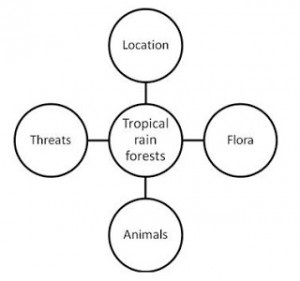
Mind Map
Flowchart
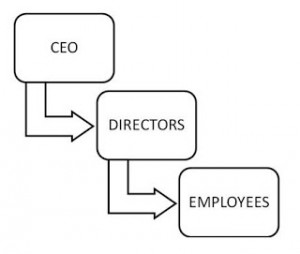
Flow Chart
Conversations
Make sure to identify clearly who says what. To do this, divide the note-taking page into two sides by drawing a vertical line in the middle and writing Man / Woman (or Woman 1 / Woman 2 or Man 1 / Man 2) at the top of each side. Then write down the information that corresponds to each speaker.